-
Horseback Riding
Horseback Riding
Whether you are an experienced rider or you’ve never been on a horse before: horseback riding in Costa Rica is an amazing experience. The local breed are creole horses (criollo). These are of smaller size than European horse and of extremely amicable temper. Therefore, they are probably the best choice for any beginner. But creole horses are also very sturdy, as they are used to the hot and humid climate. You will be amazed how amiably they are on long tours. Discover tropical rainforests, national parks, or enjoy a gallop on the beach! For fanatical riders we can even arrange coast-to-coast horseback expeditions.
Many of our staff members are passionate riders: contact us, tell us how or where you want to ride and we will propose the best option.
Tour 1 | Tour 2 | Further Tours
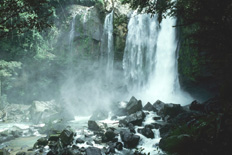
Horseback Tour to the Nauyaca Waterfall
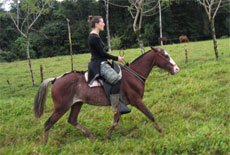
Meeting for the horseback ride at 8a.m. (not offered on Sundays). The tour leads over the road from San Isidro de El General to Dominical for about 12 km. You can deposit your car and luggage in the tour operator’s office. Bring your swimming suit along. Departure with an experienced guide for a wonderful ride to one of the country’s most beautiful waterfalls: Nauyaca. Snack break in a straw hut surrounded by various birds. Continuation through diverse landscapes, crossing a suspension bridge to take a bath in a natural emerald pool amid a lush vegetation with tiny frogs in extraordinary colours. Costa Rican style lunch in the straw hut. End of tour.
|
|
This excursion can also be done starting from Dominical or Uvita
|
 |
Back to Top
Horseback Tour to the Cabecare Natives
Moravia de Chirripo
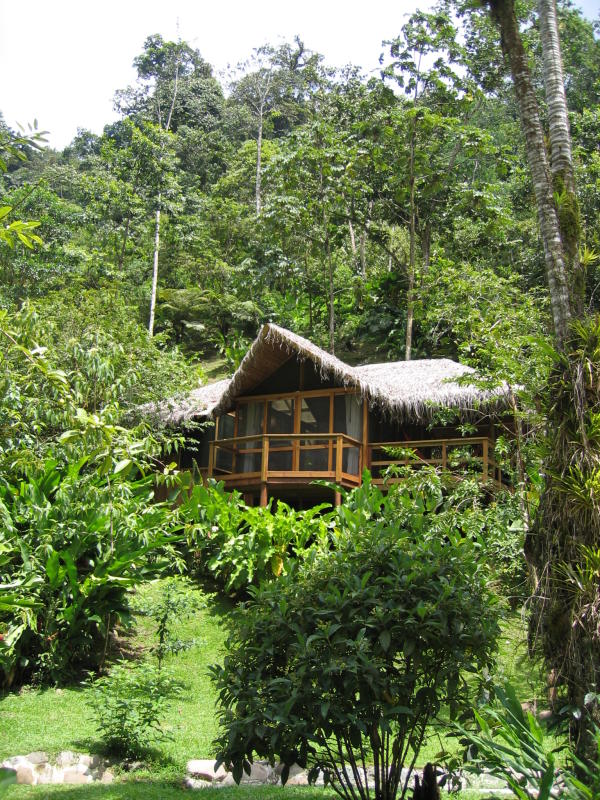
Included dinner and accommodation at the Eco-Lodge Hacienda Moravia (charming, rustic)
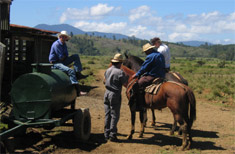
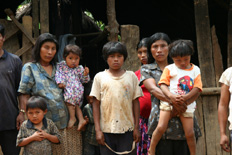
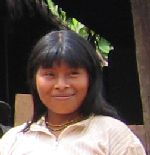
Breakfast (incl.) at the lodge. Morning horseback ride to visit the Cabecare natives (ca. 4 h). After getting to know your horse you start to a unique experience: an encounter with a Cabecare family. Accompanied by a guide you ride over the hacienda’s meadows and through primary rainforest trails to the foothills of Cerro Chirripo. Arrival at the Cabecare family. Your guide will explicate their self-sufficient way of living and their culture, which is almost completely detached from other societies. Return to the hacienda on the same path.
Important Advice: This visit is only possible if certain requirements are held. Don’t take any pictures without permission (normally your Cabecare speaking guide will arrange a photo session at the end). Do not hand out money (you will have the opportunity to thank for the visit by buying a hand-woven bag from the women). Do not enter their habitations, unless the chieftain invites you. Don’t forget to thank the chief for the visit.
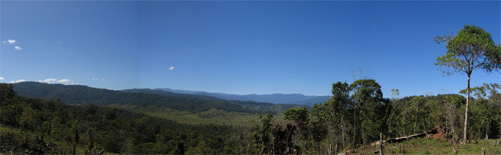
Hacienda Moravia is a wonderful place to ride: hundred horses and hundreds of cows live on the area. The property spreads over 1’250 hectares, of which half is forest. The area of Grano de Oro – where Moravia is situated – is extremely remote, between the mountain range of Chirripo and the Caribbean. There are countless riding possibilities. Some trails lead through jungle and primary forest. Also, there are extensive trails, where the cattle grazes. The managers of Moravia are happy to plan the ride you would like to do. It’s also possible to assist the cowboys driving the cattle (for experienced riders).
The Moravia excursions can also be done starting from the environs of Turrialba or Orosi
Contact Us for rates and further information.
Further Horseback Riding
There are several opportunities to ride in Costa Rica. If you are interested, ask us for more information. We will gladly make you more propositions (and some of our staff are experienced riders! . There are also possibilities for extended tours, for example the crossing of Costa Rica from coast to coast (for experienced riders: visit Andrés website www.longrider.ch to read about his horse-trekking experiences)!

Back to Top
We do our best to provide factual and up-to-date information. Any comments and additional information are appreciated.
Contact Us:
This e-mail address is being protected from spambots. You need JavaScript enabled to view it
-
Surfing
Costa Rica’s Best Surf Spots
Caribbean Coast | Southern Pacific Coast and the Osa Peninsula | Central Pacific | The Nicoya Peninsula and Guanacaste
You might think that Costa Rica’s beaches are beautiful to hang out and swim . But when it comes to surfing, there are spots that will literally take your breath away!
The swell is good all year round. And with an average water temperature of 30° C you will want to spend plenty of time in the water.
Beaches like Roca Bruja, Playa Hermosa and Pavones belong to the international top class of surfing. A 4x4 car is often needed to access the beaches – on request we organise a car with roof racks to transport your boards. Note that some airline companies do not transport surfboards. However, it is no problem to buy or rent boards in bigger destinations (as Jaco or Tamarindo).
The swell is constantly good on the Pacific, and best on the Caribbean from October until December. Remember to check tide schedules.
Caribbean Coast
Spots:
Puerto Viejo: Playa Negra is an ok surfing spot (beach break, rights/lefts), Salsa Brava is dangerous for its reef, and mostly surfed by locals. It’s considered having among the best waves of the Caribbean but clearly nothing for beginners (coral reef, rights/lefts).
Playa Cocles: is a good spot with constant waves. From Nov-Dec there are nice tubes too (beach and reef break, rights/lefts).
Playa Manzanillo: (in the national reserve of the same name), (beach break rights/lefts).
Back to Top
Southern Pacific Coast and the Osa Peninsula
Spots:
Playa Pavones on the Burica Peninsula is one of Costa Rica’s best surf spots (left point) as it features the world’s second longest continuous left (over 1 km).
The best surf spots on the Osa Peninsula are:
Cabo Matapalo (a world class right reef break with good, continuous waves)
Bahia Drake (coral reef rights/lefts) and Carate (beach break rights/lefts) – which lies in the Corcovado National Park and is therefore a little complicated to get to.
Playa Dominical is also a famous spot, known for the variety of its waves on high and low tide (rights/lefts) and beginners can also dare a come here.
Back to Top
Central Pacific
Spots:
Manuel Antonio (good right and left peaks), Punta Quepos (left point) and Parrita (beach break, rights/lefts).
Playa Hermosa has nice, continuous waves on a 7 km beach, and hosts a famous annual surfing contest in August. Not suited for beginners (right point break).
Jaco is average, with river mouth surfing (beach break, rights/lefts).
Back to Top
The Nicoya Peninsula and Guanacaste
Spots:
|
Malpaís has some good, constant waves.
Playa Santa Teresa (beach break, rights/lefts) with its powerful waves is only accessible by 4X4.
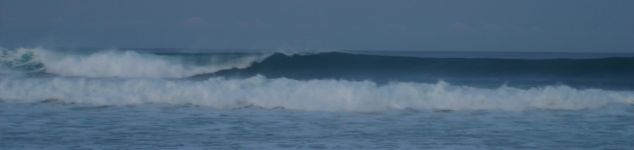
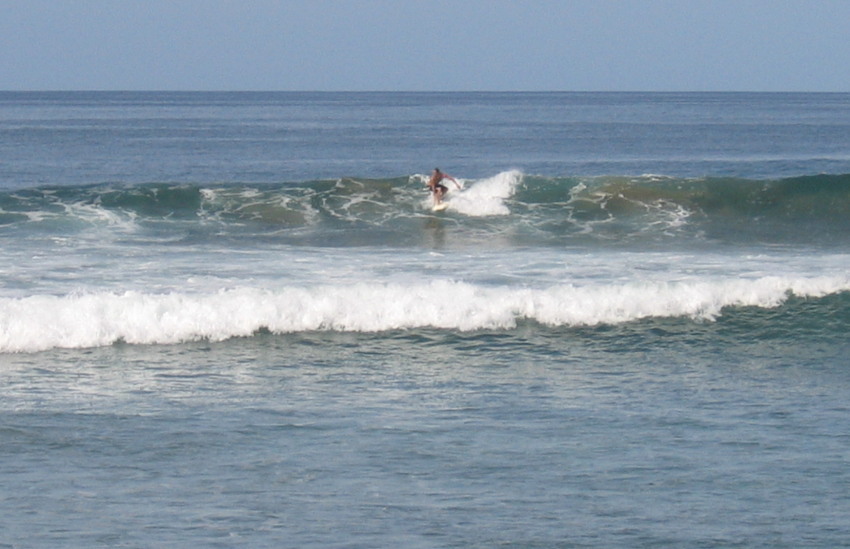
Playa Negra features one of Costa Rica’s best rights and can be surfed with any tide (rights/lefts) and Playa Avellana (rights), are both appreciated by surf aficionados.
|
Playa Negra
|
Playa Tamarindo (beach break, rights/lefts) is probably the best spot for beginners and surf lessons are easily available.
Playa Grande (beach break, rights/lefts) is one of the country’s most famous spots with offshore winds and nice tubes.
|
Santa Teresa, Nicoya Peninsula
|
Close to Playa Naranjo, lies legendary Witch's Rock featuring fast waves with perfect tubes (beach break, rights with good offshore winds) and Ollie's Point , an exclusive location as it is difficult to access, i.e. only by boat (perfect rights). Both these locations are known from the surf movie “Endless Summer 2”.
| Note: On request we will gladly inform you about surfing lessons or stays at one of Costa Rica’s various surf camps (e.g. in Tamarindo or Malpaís/Santa Teresa). |

Activities Overview | Back to Top
We do our best to provide factual and up-to-date information. Any comments and additional information are appreciated.
Contact Us:
This e-mail address is being protected from spambots. You need JavaScript enabled to view it
-
Diving
Costa Rica’s Best Dive Spots

Although visibility is less convenient in the Pacific than in the Atlantic Ocean, there are some fascinating diving possibilities (there are no diving operators on the Atlantic). You can observe manta rays, sharks, whales, sea perches of all kinds as well as countless reef fishes. The best spot is by far Isla del Caño.
Caribbean Coast
Dive Spots:
Snorkeling is allowed in Cahuita National Park and recommendable at Manzanillo, where you find relatively calm reefs. There are no diving operators on the Caribbean coast.
South Pacific and Peninsula de Osa
Dive Spots:
The best spot for diving in this area is without a doubt Bahia Drake from where you can access the Isla del Caño. The water around this island reserve is amazingly rich with plankton. The abundance of fish is incredible and on the way to Isla del Caño you often encounter dolphins, whales and sea turtles!
Central Pacific
Dive Spots:
There are no noteworthy dive spots in this region. Some diving operators can be found in Manuel Antonio, but the diving is mediocre.
Nicoya Peninsula and Guanacaste
Dive Spots:
We cooperate with Bill Beard’s Diving, a professional and experienced operator. Playa Hermosa is the starting point for snorkelling or divin around the island Santa Catalina. The island is not accessible. You can dive/snorkel around its rocky surroundings to observe manta rays, whitetip reef sharks and various reef fishes, such as parrotfish, clownfish, etc. On the 1.5 hour trip to the island you have the chance of seeing whales (sometimes orcas!) and dolphins. There are also other dive spots off Tamarindo.
Back to Top
We do our best to provide factual and up-to-date information. Any comments and additional information are appreciated.
Contact Us:
This e-mail address is being protected from spambots. You need JavaScript enabled to view it
-
Fishing
Costa Rica’s Best Fishing Spots
 Caribbean Coast | Southern Pacific Coast and Osa Peninsula | Central Pacific | Nicoya Peninsula and Guanacaste
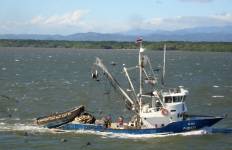
Although offshore fishing is not particularly cheap Costa Rica is one of the most frequented countries for this activity. Several operators offer their services. We have chosen the most reliable ones with the best value for money.

Caribbean Coast
Barra del Colorado is an exclusive place (and only accessible by plane) to catch tarpons, barracudas, mackerels, pikes and more.
Southern Pacific Coast and Osa Peninsula
Golfito is the starting point from one side of the Golfo Dulce, Puerto Jimenez serves the other side.
Central Pacific
There are several fishing operators in the area of Manuel Antonio and Punta Leona.
Nicoya Peninsula and Guanacaste
There are professional fishing operators in Tambor/Malpais. There is also the possibility of joining local fishermen for a tour at very reasonable prices. The most important location for big game fisching is Flamingo.
Back to Top
We do our best to provide factual and up-to-date information. Any comments and additional information are appreciated.
Contact Us:
This e-mail address is being protected from spambots. You need JavaScript enabled to view it
-
Beaches
The Beaches of Costa Rica
Swimming Beaches: Although it is often promoted as a prime beach location by various travel magazines, guidebooks and press articles, Costa Rica is not a classical location for swimming beaches. There are plenty of picturesque beaches, particularly on the Caribbean coast. But the sea is very agitated in many places and its currents often deter from tranquil swimming. Hence, we give you an overview of Costa Rican beaches for beach holidays, so you know what to expect on your vacation.
Caribbean Coast | Southern Pacific/Osa Peninsula | Central Pacific | Nicoya and Guanacaste
Beaches on the Caribbean Coast
Swimming Beaches (from north to south)
- From Boca del Rio Colorado over Tortuguero until Puerto Limon: the beaches are straight and dangerous due to strong undertows. Swimming is not allowed in Tortuguero National Park in order to preserve the turtle population.
- From Puerto Limon to Cahuita: the coast in this section is hardly interesting.
- From Cahuita to Manzanillo: Playa Negra – as its name indicates – is a black volcanic beach. Playa Cocles *** is a bright sand beach of 2 km length. This is probably Costa Rica’s nicest Caribbean beach. Playa Chiquita ** is a charming little beach with bright sand.
- Playa Manzanillo is among Costa Rica’s most pleasant beaches. South of Playa Uvita (the most romantic of Costa Rica’s Caribbean beaches), this beach is situated in a National Park and offers one of the two main spots for reef snorkeling on this coast.
Caribbean Beaches: Pictures
Back to top
Beaches on the Southern Pacific Coast and Osa Peninsula
Swimming Beaches
There are untouched beaches on the Burica Peninsula but the ocean is quite agitated and therefore not very convenient for swimming. The Golfo Dulce is a bit polluted, as it is more of a lake than an ocean… The beaches around Puerto Jimenez ** are acceptable and you can often spot dolphins here. The area’s best swimming beaches are around Bahia Drake **. The nicest one probably being San Josecito ***, a small beach with bright sand, which is only accessible by boat. Between Sierpe and Dominical there are mangrove woods, pristine beaches and rocky coasts, but swimming can be dangerous due to strong currents.
Southern Pacific Beaches: Pictures
Back to top
Beaches on the Central Pacific Coast
Manuel Antonio National Park features bright sand beaches *** that are well protected from the currents. The public beach is (too) frequented… The coastline between Quepos/Manuel Antonio and Jaco is quite straight, with alternating rock and sand beaches (like Parrita). Strong currents and big waves greatly reduce the swimming pleasure. Jaco is one of the area’s most frequented beaches, as it is closest to San José. The beach of Punta Leona** is a better option in this vicinity (its beaches were used for the film “1492 – Conquest of Paradise”). The northern beaches up to the Gulf of Nicoya are not apt for swimming.
Central Pacific Beaches: Pictures
Back to top
Beaches on the Nicoya Peninsula and Guanacaste
The regions of the Nicoya Peninsula (and Guanacaste) offer the best swimming beaches. In this region (as well as in most of the country) the beaches are narrow, not leaving much space for sunbathing (descriptions of the peninsula are made counter-clockwise):
- Playa Tambor** is a long, bright sand beach and relatively protected from the tides.
- The peninsula’s southern tip features some nice pristine beaches (Montezuma, Malpais, Santa Elena**) but they are mostly also affected by strong tides.
- Playa Carillo ** and Playa Samara ** are two well-protected beaches with gray sand.
- Around Tamarindo Playa Langosta * is an acceptable place, as well as Tamarindo’s public beach*.
- We personally recommend Playa Real *** as one of the country’s best: it is well protected, has clear sand and is relatively big. To the north lies Playa Conchal **: as hinted by the name its sand consists of crashed conches (shells).
- More to the north you find Playa Flamingo *, which is acceptable, and particularly Playa Pan de Azucar **, a bright sand beach surrounded by small islands. Playa Ocotal ** in the environs of del Coco is situated in a small bay and pleasant due to its tranquillity. Playas del Cocoand Hermosa are not very exciting. Playa Panama * and the beach at Bahia Culebra **are nicer.
- Playa Naranjoin the Santa Rosa National Park is very agitated (and therefore a famous surf spot, hardly adequate for swimming).
- A little off, close to the Nicaraguan border you find practically deserted beaches in the Gulfs of Santa Elena and Bahia Salinas, for instance the clear sand beaches Pochotes * and Mostrencal ***.
Nicoya and Guanacaste Beaches: Pictures
Back to top
-
Playing Golf in Costa Rica: Resorts, Golf Courses
Playing Golf in Costa Rica
Central Valley | Guanacaste | Central Pacific
In 1944 Costa Rica’s first golf course (9 holes) was created as part of the Costa Rica Country Club. The place was located in Cariari (on the road to the international airport). In the 1970’s George Fazio redesigned the place and extended it to 18 holes. Since then, five further 18-hole-courses have been added (ande over 20 9-hole-courses). The prestigious Four Seasons in the Papagayo Gulf (Guanacaste) is the newest one. Many golfers adore Costa Rica for its picturesque, varied courses between volcanoes and tropical seas…
Golf Courses in the Central Valley
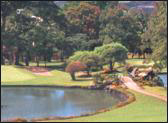 Melia Cariari Country Club (Cariari)
Costa Rica’s oldest golf course. An undulating, shadowy course, which was designed by George Fazio. It is located in the nice residential area of Cariari, 10 minutes from the international airport and 20 minutes from San José’s centre. Several international competitions are held on this pleasant course amid coffee plantations.
Par 71
This old private golf course is now owned by the Brazilian Habitasul and was redesigned by the architect Tracy Mayce. It lies in the vicinity of Santa Ana, a pleasant residential area outside San José. Its varied, undulating course among small lakes and tropical trees holds a renowned amateur tournament every July.
Par 72
Golf Courses in Guanacaste
Garra de Leon was designed by Robert Trent Jones and is located on the property of the luxury hotel Paradisus Playa Conchal (of the Sol Melia chain). It is pleasantly situated above the Pacific Ocean, in a dry tropical Guanacaste forest. Without a doubt this is one of the nicest courses in the country, due to its exceptional environment. The vicinity to the ocean and the tropical setting and sounds make this a little paradise indeed!
Par 72
Mike Young has recently designed this course on the property of an old ranch, south of Tamarindo.
It is nicely located above the ocean, but in our opinion the course does not offer enough shade to play (the sun being very hot in this region).
Par 72
This course is situated on the property of the prestigious Four Seasons hotel and was designed by Arnold Palmer. 14 of the 18 holes feature a splendid view over the Pacific Ocean and the Papagayo Gulf. This green is a known golf course and it’s frequented by the international jet set.
Par 72
Golf Courses in the Central Pacific Area
Only two hours away from the capital you find this course, designed by Ted Robinson Jr, on the premises of the Marriott Hotel Los Sueños. It is perfectly set in beautiful nature, with the Pacific coast on one side and a tropical forest on the other. Its lovely setting will be a great motivation to play another round!
Par 72
Back to Top
We do our best to provide factual and up-to-date information. Any comments and additional information are appreciated.
Contact Us:
This e-mail address is being protected from spambots. You need JavaScript enabled to view it
-
Private Aviation - Ballooning
Private Aviation
Airplane | Helicopter | Hot-Air Balloon

Airplane Tours| Balloon Tours
Airplane and Helicopter
Departure and landing at TOBIAS BOLAÑOS International Airport in Pavas. We can arrange flights in a 5-seat CESSNA 206, in larger planes for 7-12 passengers, or in a BELL 407 helicopter. This is certainly one of the best ways to explore the topography and geography of the country and its many volcanoes. The Costa Rican pilots are experienced and trained according to American standards and the machines are properly maintained.
Hot-Air Balloon Ride
The balloon departs from Muelle in Turrialba with good weather conditions only. The company flies hot-air balloons in Costa Rica since 1991 and has according experience. The company works with high security standards, which are approved by the American Federal Aviation Administration and the Civil Aviation Institute of Costa Rica. The equipment is well maintained, the pilots are experienced and the company is adequately insured.
SINGLE ENGINE AIRPLANES
|
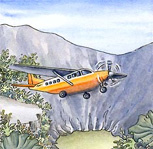 CESSNA GRAND CARAVAN 208 B CESSNA GRAND CARAVAN 208 B
8 to 12 passengers + 1 pilot.
1 turbo propeller with 600 horsepower.
Cruising speed: 180 kt (340 km/h). Maximum loading (passengers and cargo): 454 kg.
Our Opinion: A convenient plane for quick flight from one end of the country to another. The machine is adapted for landings on rough terrain. Good price performance ratio.
|
| |
|
|
|
|
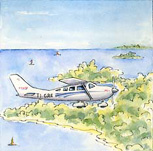 CESSNA 206 CESSNA 206
5 passengers + 1 pilot.
1 turbo propeller with 300 horsepower. Cruising speed: 142 kt (232 km/h). Maximum loading (passengers and cargo): 386 kg.
Our Opinion: Suitable for low-altitude and photography flights. Very good visibility due to the wings being over the windows. If weather conditions are good the doors can be removed for better views.
|
DOUBLE ENGINE AIRPLANES
|
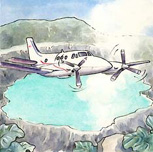 BEECHCRAFT KING AIR E 90 BEECHCRAFT KING AIR E 90
7 passengers + 1 pilot.
2 turbo propellers. Cruising speed: 215 kt (398 km/h). Maximum loading (passengers and cargo): 907 kg.
Our Opinion: A good choice for quick transfer flights with a lot of luggage.
|
| |
|
|
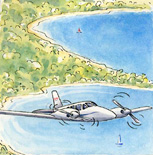 PIPER SENECA II PIPER SENECA II
5 passengers + 1 pilot.
2 turbo propellers with 360 horsepower. Cruising speed: 174 kt (323 km/h). Maximum loading (passengers and cargo): 431 kg.
Our Opinion: A good choice for quick overflights on a small scale.
|
HELICOPTER
 BELL 4076 passengers + 1 pilot. BELL 4076 passengers + 1 pilot.
1 Rolls-Royce motor with 650 horsepower. Cruising speed: 136 kt (250 km/h). Maximum loading (passengers and cargo): 454 kg.
Our Opinion: This helicopter is well suited for low-altitude photography flights as it offers excellent visibility. |
HOT-AIR BALLOON
 Hot-Air Balloon with a wicker basket for 5 passengers and a pilot. The flying materials are verified by the US-American „Federal Aviation Administration“ (FAA) and the Costa Rican Civil Aviation Institute. Flights take off from the regions of Arenal or Turrialba. Hot-Air Balloon with a wicker basket for 5 passengers and a pilot. The flying materials are verified by the US-American „Federal Aviation Administration“ (FAA) and the Costa Rican Civil Aviation Institute. Flights take off from the regions of Arenal or Turrialba.
Our Opinion: Seeing the varied Costa Rican landscapes from above makes a fantastic experience you will not forget. Note that flying weather is best in the early morning. |
Individual transfers to and from Pavas Airport are included
Back to Top
Some Tour Ideas for Plane and Helicopter
(The descriptions below are based on the CESSNA 206 model)
A tour of the most beautiful volcanoes and the Central Valley
Flight Time: 1h 15 min
Overflight of Poas volcano with its huge active crater (fumarole activities) and the navy blue lagoon. Continuation over the extinct volcano Barva, covered by dense vegetation, and the active Irazu (the highest volcano of Costa Rica with 3432 m) and its famous emerald green sulphurous lagoon. Finally, you will fly over the slightly active Turrialba volcano whose cone towers above the spectacular valleys of Orosi and Turrialba. Return to Pavas. An exceptional volcanic discovery tour!
Tortuguero National Park
5h (of which 2 x 50 min Flight Time)
A good option to save time reaching Tortuguero and simultaneously witnessing the brisk shift of vegetation from the Central Valley to the Caribbean.
Flight over the cloud forests and high peaks of Braulio Carillo National Park and its many streams and waterfalls. After reaching the Caribbean plain you will fly over vast banana plantations and mangrove forests until landing on Tortuguero airstrip. After breakfast at a lodge (e.g. Samoa Lodge) there will be a guided boat tour through the jungle canals, where you will find an abundance of plants and wildlife. You can easily spot one of the numerous species of monkeys, crocodiles, iguanas, sloths, toucans, parrots and sea birds… Subsequent return to Pavas.
Poas and Arenal, the Fire Mountains
Flight Time: 1h 15 min
Flight over Poas volcano and the lush San Carlos Valley where the majestic silhouette of Arenal volcano (1600 m) appears in the distance. Arenal with its perfect cone shape towers above the surrounding cloud forests. Since its explosive awakening on 29 July 1968 it regularly discharges lava streams. It is one of the world’s most active volcanoes and has been closely studied by volcanologists for over 25 years. Lake Arenal forms one of the country’s biggest fresh water reserves and is surrounded by a beautiful mountain scenery. A breathtaking excursion! Subsequent return to Pavas.
Fly over Jurassic Park
Manuel Antonio, Dominical, Osa Peninsula
Flight Time: 3h
Departure towards Manuel Antonio National Park over the mountains of the Central Valley. Continuation along the southern Pacific Coast over the beaches of Savegre, Matapalo, Dominical, Punta Uvita and Bahia Ballena… then over the turquoise waters of the Golfo Dulce and Puerto Jimenez to the luscious vegetation of the Osa Peninsula with the huge Corcovado National Park. Return over San Isidro del General and the Cerro de la Muerte (on an altitude of 3500m) towards San José and landing at Pavas Airport.
|
Note: The denoted flight time is merely approximate. If you would like to fly over other places this can be easily arranged – the flight time will prolong accordingly. In this case you would pay the additional costs directly to the flight agency (the charges will be calculated according to the airplanes’ odometer).
|
Further Offers: Single or Round Trip Flights to Bocas del Toro (Panama), Granada (Nicaragua), San Andres (Colombia)…
Hot Air Balloon Ride
Departure from Turrialba or environs: Flight time: 45-90 min
Breakfast at the hotel. Meeting between 5-6 am to benefit from optimal atmospheric conditions in the early morning. The balloon ride will take between 45-90 minutes and can only take place with good weather. The flight will lead through the nice mountainous area around the southern Central Valley. You will fly over, or close to, the volcanoes Irazu, Turrialba and Cerro Chirripó (3820 m) – the highest point of Costa Rica. Expect an eventful morning with magnificent sights in thin air!
Back to Top
We do our best to provide factual and up-to-date information. Any comments and additional information are appreciated.
Contact Us:
This e-mail address is being protected from spambots. You need JavaScript enabled to view it
-
White Water Rafting
White Water Rafting
|
|
Costa Rica is a fabulous country for white water rafting! Tropical temperatures assure warm water. Intact nature provides beautiful settings for this activity. And the experienced local river guides are great to paddle with. Franck, our local manager in San José, has been a rafting guide for years. He handpicks the best rafting suppliers and personally verifies their quality and safety. |
|
Best Rafting in Costa Rica: Rio Pacuare
Early shuttle transfer from your hotel to an unforgettable experience on the Rio Pacuare, east of San José (difficulty: class III-IV. Accessible for beginners but a good physique is mandatory). The river runs through unique tropical nature, crossing an Indian reservation. This is one of the most scenic rivers for white-water rafting in the world. You will encounter various animals, such as sloth, herons, kingfishers, hawks and further birds. Calm passages alternate with rapids and provide for an eventful day of paddling! You will be supplied with equipment and catering. The guides speak Spanish and English. Return to the hotel in the afternoon or ovenight at the Pacuare Lodge in the middle of the jungle!
We do our best to provide factual and up-to-date information. Any comments and additional information are appreciated.
Contact Us:
This e-mail address is being protected from spambots. You need JavaScript enabled to view it





 Parque Valle del Sol
 Garra de Leon
 Hacienda Pinilla
 Golf Club of the Four Seasons Hotel
 Golf Resort Marriott Los Sueños