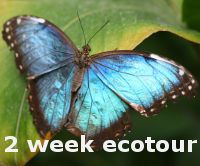
- Educate yourself and your children: experience the ecological wonders of Costa Rica and learn more about their importance in our educational eco tours!
- By paying the entrance fee of any protected zone you contribute to its further preservation.
- Stay on marked trails and do not disturb wildlife.
- Do not litter. Picking up other peoples’ waste is a generous extra contribution!
- Please do not feed wild animals (although some species will serve themselves…)
- Choose sustainable eco lodges over large hotel complexes
- Inform yourself about present conservation concerns of your destination country.
- Respect the local culture and rules.
- Save water and use a fan instead of AC.
- Outside the country: make sure you buy organic coffee, bananas and pineapples that do harm the ecosystem as little as possible. Also, consider the long transport routes necessary.
The Development of Ecotourism
Travelling is a long-standing human habit. Once, it used to be necessary to find new sources for food and agriculture. In the 19th/20th century this changed: people began to discover travelling as a personal experience. They wanted to find things unknown and discover new cultures. A new class was born: the tourist.
Back in the day, recreation and cultural education were the tourist’s main interests. But with evolving industrialisation and advancing environmental problems, there was a new thing that was becoming rare: intact nature. In the 21st century the desire to experience pristine nature became yet more urgent, giving birth to the eco traveling industry. Environmentally involved travellers want to see wildlife and their natural habitats before it is too late. At the same time, they have a chance to contribute to natural preservation (see below).
One of the latest trends in eco-tourism and adaptation of the principles thereof has been with the African safari industry. A number of African safari guides and lodges have for years stayed silent about the growing environmental hazards of mass visitation of protected areas. In recent years there has been more of an effort to use it as marketing tool, but the with advent of an increasing number of European and American tourists a greater level of involvement and attention to the issues have had to be reached and standards adopted.
The human need for nature: Biophilia
An interesting scientific idea that can explain recent tendencies towards ecological travel is Biophilia, a concept by Harvard biologist E. O. Wilson. It suggests that we depend on interactions with nature and wildness. Because humans evolved over generations within nature and in interactions with other species in the wild, we have an instinctive need to experience natural habitats and wildlife.
Costa Rica and Ecotourism
With over 300’000 National Park visits per year, Costa Rica is among the world’s first eco travel destinations. A fourth of the national territory – 1.1 million hectares – are natural reserves! Despite of the still present menace of deforestation, Costa Rica has a fairly good environmental record. Ecotourism has done a lot to initiate the country’s interest in preserving its biodiversity. 1970 was an important year from that aspect: wildlife trade laws were enacted and the National Park Service (SPN) was founded.
Costa Rica has about 161 national parks, refuges and other protected natural areas. The protected areas represent nearly 26% of the Costa Rican territory, or 1304306 ha. While Costa Rica covers only 0.04% of the earth's land area, a stunning four percent of the world's of the world's terrestrial diversity is located here!
According to a report of the universities of Yale and Columbia (presented at the Davos Forum on January 23, 2008) Costa Rica is ranked as the 5th most advanced country in natural preservation. In addition, Costa Rica is among a group of countries that declared the aim of leading their economy to “carbon neutrality” by reducing their COs emissions. This program was taken over by the United Nations Programme for Environment (PNue). Costa Rica committed itself to becoming climate-neutral by 2021 at the 200th anniversary of its independence, (September 15, 1821).
For some, eco friendly travel in combination with a transatlantic journey seems a contradiction in terms. It is true, CO2 emissions of aviation are immense. But there is a middle way between cold-blooded relentless flying and staying at home: plan your trips with consideration. If the flight to your destination takes you more than 6 hours, decide to stay for at least 3 weeks – or more if possible. Give up your weekend trips to visit random European cities just because the tickets are cheap. Fly as little as you can and you will appreciate your extended trips even more.
Make no doubt about it: the effects of human civilisation endanger our planet. When it comes to CO2 aviation is one of the main pollution factors. It is almost impossible to compensate this otherwise. Nevertheless, if you fly or not, here are some basic rules of conduct that help preserving energy and natural resources:
- Eat locally: buy food during the right season and make sure it hasn’t travelled around the world. Consider this: if you quit drinking wine from the other end of the world (e.g. Australia), you preserved a lot of energy without forbearing from travelling.
- Eat less meat and fish.
- Walk whenever you can. Every meter you cover on foot is energy saved for cars, escalators, lifts, even busses.
- Take showers instead of baths.
- Don’t waste soap and detergent.
- Turn down the heating and don’t switch on the AC.
|
Visit these links to get an idea of your climate footprint:
|