Alphabetic
Index
Amphibians
Reptiles
Birds
Mammals
Insects
Back to
Overview
The Reptiles of Costa Rica
Crocodiles | Turtles | Lizards | Snakes
Reptiles arose in the Palaeozoic Era, 300 million years ago. Today there are over 6000 reptile species, sharing the following traits: they are of mostly inconspicuous colours and behaviour; their heart is divided into several chambers to increase blood pressure (and hence muscular activity); most reptiles’ skin is covered with scales to reduce water loss from their body surface.
There are 3 groups of reptiles: Crocodiles, Turtles, Lizards/Snakes
Interesting Facts:
A fascinating attribute of reptiles is that their sex is largely determined by the temperature at which the eggs develop in the ground. This is because all crocodilians and many turtles and lizards do not have the sex-determining X or Y chromosomes. Hence, temperature conditions decide for their sex. Some turtle eggs, for instance, develop as females when incubated at temperatures above 30° C, and as males when incubated at temperatures between 24-28° C!
(This is an important fact to remember when calculating the size of marine turtle refuges: as temperatures vary on beaches, there is the risk of protecting a beach where only male turtles will hatch. This will not enable the specie to reproduce further. It is therefore fundamental to implicate this knowledge and make sure that beach areas are protected where similar amounts of male and female turtles will hatch.)
Crocodiles (esp: cocodrilo)

American Crocodile
The American crocodile is a large crocodilian that can reach lengths up to 7 metres (4 m being average adult size).

Interesting Facts:
It is not always easy to distinguish crocodiles from caimans. The snouts are a good indicator: caiman’s snouts are broader and rounded, those of crocodiles more pointed. Their behaviour is a further sign: caimans are generally shyer. So another rule of thumb to determine a crocodilian is the following: if it runs away it’s a caiman, if it eats you it’s a crocodile…

The Caiman is generally shy and of small size (up to 2.5 m). It is the most widespread crocodilian in the world and can be found on both the Caribbean and Pacific slopes of Costa Rica.
Lizards | Snakes | Back to Top
Turtles & Tortoises (esp: tortugas)
Turtles are a 200 million year old species that can be divided in water (sea/freshwater) and land turtles. Their characteristic feature is the shell, which consists of two layers: an inner layer of bone and an outer layer of scale-like plates. They are able to retreat their feet and head into the shell for protection. Turtles can live for 25 to 65 years. There are only marine and freshwater, but no land turtles in Costa Rica.
Sea Turtles

Green turtles are found on both coasts. They nest between July-October on the Atlantic and from October-March on the Pacific coast. Green turtles have a length of about 80 cm and weigh between 65-120 kg. Nutrition: algae and sea grasses.
Leatherback turtle is the largest and most impressive turtle specie with lengths up to 2.5 m and weights up to 1 ton! They can be observed on the Pacific coast between October and March, when they come to lay their eggs. The name stems from their leathery skin with small embedded bones, which they have instead of a shell. Bathers will be happy to know that leatherbacks feed mainly on jellyfish.
Contact us if you are interested in a turtle tour, for instance in the famous Tortuguero National Park.
Olive ridley turtles are the smallest sea turtles in Costa Rica with a shell length of 55-75 cm, weighing 35-45 kg. Nutrition: molluscs, crabs, jellyfish.
Crocodiles | Turtles | Back to Top
Lizards & Snakes
Lizards are mostly carnivorous and insectivorous but some larger ones eat plants. Snakes probably evolved from lizards (when their legs retreated due to unemployment) and are exclusively carnivores.

Interesting Facts:
Many lizards have an interesting self-preserving mechanism: when grabbed forcefully by the tail, they can break it off. This is known as “tail autonomy” and can actually be observed with many lizards (e.g. geckos).
Lizards
Of about 600 iguanid species, 38 can be found in Costa Rica. Let us take a look at the three most common ones:
Green Iguana
Breeding occurs during dry season, when the female lays clutches of ca. 40 eggs. After 11-15 weeks of incubation the hatchlings emerge. As they lack dorsal spines, they are more resembling to female iguanas than males.

|
Interesting Facts: First described in 1758, by the Swedish botanist Carl Linnaeus, this specie is also locally known as “chicken of the tree” (“gallina de palo”). This is due to their being an easily accessible source of meat. With increasing prosperity the demand for iguana meat is currently decreasing. Let us hope that the food shortage threatening particularly the poorer areas of the world won’t change this (not just for the iguana’s sake, of course). |

Ctenosaur
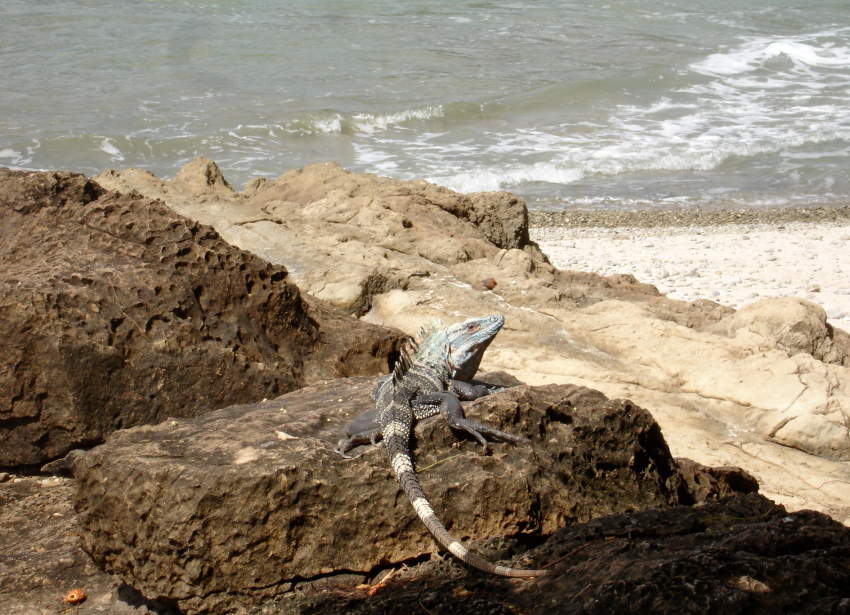
Interesting Facts:
With a speed of 35 km/h the Costa Rican “ctenosaura similis” actually attained the local sprint record.
Plumed Basilisk (Jesus Christ Lizard)

Gecko (esp: geco)
It is still widely unknown what exactly enables geckos to defy gravity and adhere to vertical surfaces. It seems that tiny hair-like structures on the toes allow attachment to walls (by what is known as van der Waals force).
Crocodiles | Turtles | Back to Top
Snakes (esp: culebra)

There are 162 snake species in Costa Rica, of which 22 are poisonous. Despite their bad reputation the chances of actually seeing a venomous snake are rather slim. They are not only sedentary and nocturnal, but also hard to spot for the untrained eye.
There are two main groups of venomous snakes in Costa Rica: Pit Vipers and Coral Snakes. Pit vipers include the notorious Fer de Lance, the Eyelash Viper, the Bushmaster and the neotropical rattlesnake. Pit vipers can be detected by their triangular head, which sticks noticeably out of the body. Their venom breaks down tissue near the bite location and can affect the nervous system. The Fer de Lance (terciopelo) is a large specie, responsible for most bites in the country.
Colubrids – of which most are unpoisonous – are the most common snakes. It is hard to distinguish them, but the main difference is the lack of venom-injecting fangs on the upper jaw. Mostly, they have long and slender bodies that enable them to live on trees (in contrast, vipers are slower and more heavy-bodied).
Bushmaster
With maximum lengths of over 3 metres, the bushmaster is the largest venomous snake of the Neotropics. Because they live a nocturnal life (like most venomous snakes) they are hard to spot. Unlike most vipers, bushmasters don’t give birth to live young, but lay clutches of around 10 eggs.
Coral Snake

Fer de Lance (esp: terciopelo)


Crocodiles | Turtles | Lizards | Back to Top